On a daily basis our characters’ unique personalities pull our thoughts toward the concept of perception. “Fleas know not whether they are upon the body of a giant or upon one of ordinary stature,” wrote the poet Landor. As a flea in the world of writing, I know that Angelica is giantesque.
Zi was immediately interrupted by Angelica asking, “Where are you going with this? Is this about my weight?”
Zi replies, “Weight? You’ve weight?” And he smiles.
We understand that perception is reality and our job as writers is to take that word clay and prepare it for the kiln so when fired it creates images. Some are thought provoking, others ugly, some funny. But there are those days when we utterly fail to understand. Thus, bringing to our humble attention one very simple fact, we like many of our manuscripts are works in progress.
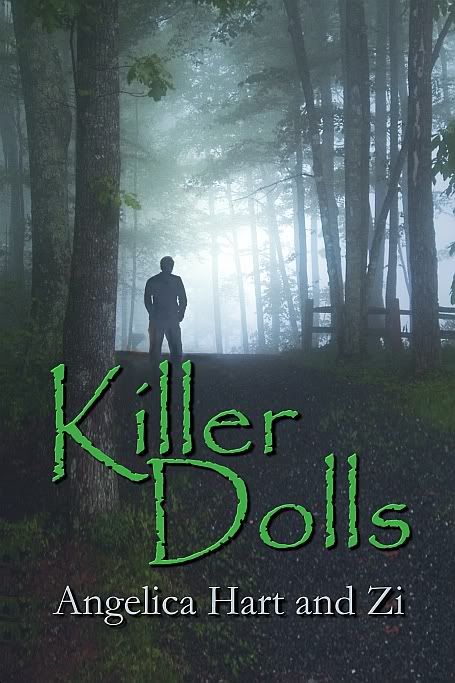
Below is an excerpt from KILLER DOLLS, a soon to be Champagne Books release, we hope you enjoy it.
EXCERPT TWO
They got a room, asked to use the phone, storm had the lines down, asked about a cell phone and the clerk, a man of advanced age, looked at Taut as if he were an alien, paid in cash, parked out of view, and entered a nice but tacky cabin room.
“I see that shabby-chic is nouveau. The guest towels say… well used. Look, a bottle of shampoo. I used this stuff when I was a kid. It bubbles." Letti was rambling and gently ranting to cover her fear. She now understood the gravity of the situation; it was real, though she did not know why two very evil men were chasing them. Nor why they had her dolls. Why? The dual whys came out in unattractive rumbling, its blasphemy a cruel sacrilege.
“I am sleeping where?” asked Taut. The room had one bed.
“Between me and the door… and that window.”
_____
We'd love to hear from anyone interested in what we do. Anyone who writes us and leaves an s-mail address, we will send you a gift and add you to any future mailings.
Angelica Hart and Zi
KILLER DOLLS ~ September 2009
SNAKE DANCE ~ February 2010
CHASING GRAVITAS ~ July 2010
angelicahartandzi@yahoo.com
angelicahartandzi.com
KILLER DOLLS can be purchased at
Champagne Books
http://www.champagnebooks.com/
There are so many promotional opportunities for writers nowadays. How do you know which are the most effective?
I try to write two books a year. In addition, I hold a full time job and have family responsibilities. I’m on Myspace, Twitter, I maintain a blog on my website, and I belong to a group blog, The Writers Vineyard. Plus I write the occasional article at various guest blogs and promo sites. I don’t always have time to fit everything in. In fact, oftentimes I feel like I’m running around doing ten different things at once.
Do the majority of these things work as effective promotion tools? My friends twelve year old claims Myspace is “Soooo yesterday.” Twitter, or Tweeting, she says, is “like totally rockin’.” Ok, so maybe I should focus on my Tweets.
But I like to guest blog. I love meeting new readers, visiting others’ sites, and hopefully gain a few new followers who might not have found me on my own site.
So what works? I’m not altogether sure, but I press on. I might not be the most organized person in the world, but I’m getting my name out there. And hey, when I pen the next bestseller, people will sure know where to find me!
Last of all, I had to tell Annalee about the trip with Hal. "Hope you don't have any dates for us the week before Christmas," I began.
She widened her golden eyes at me, then shut them and winced. "Not again, Arno. Please don't tell me you're flying off somewhere at Christmas time."
What could I say to her, my beautiful Annalee? In a way it'd be easier not to be here at Christmas, not to look at each other, knowing all our attempts to produce our own little Christmas angel had failed. But I couldn't say that. She'd begun to talk adoption, but I want my own kid, not someone else's. Wrong-headed, maybe, but I often am, much as I love Annalee.
"I've never been gone at Christmas before," I pointed out.
"Maybe not. But how about my sister's wedding? And the Gilbert's anniversary party? I'm getting fed up with having to break commitments because you suddenly get an urge for the wild blue yonder."
"This time it's strictly business. Hal Peterson is stuck with a demand trip to Central America, and he needs a pilot." Which was more or less true.
She told me where I could go, what Hal could do with the trip and where the plane could be put, permanently. Annalee has quite a vocabulary.
Then I got the silent treatment, with Rufus our cat glaring at me balefully. He hates it when we have a disagreement. The day before I left, visualizing her putting up the damn hokey tree and decorating it all by herself, I promised to be home in time to help her if it killed me. So then we had a tearful parting scene after all.
What worries my wife is that I'm going to crash. I've shown her statistics, even acted insulted because she doubted my flying ability, but nothing can convince her that small planes are safe. Though most private plane crashes are pilot error, try to convince Annalee. She sees them as instances of some huge hand plucking the plane out of the sky on a whim. Try to argue with that.
Every writer needs an editor. A qualification to that assertion: Every writer who expects or wants to be published, requires an editor in his corner. And in using the “in your corner” metaphor, I don’t necessarily imply a supporter, although he/she certainly could be. It’s more like the pugilist’s “cut man”– someone to stave the flow of blood, tape over the wounds, and shove you back into the ring when the bell sounds.
The professional writers who may be reading this know what I will expound here, and are excused. It’s you aspiring authors to whom this is addressed.
There are three stages of editing before publication, with the initial stage, self-editing, being perhaps the most important. There was a golden time, I’m told, when the gift of story telling, in handwritten script, or composed on old-fashioned typewriter keys, was all that was necessary to sell a story or a book. Someone from the publisher’s editorial staff who worked closely with the artist-writer coaxed the promising tale into publishable form. Those good old days have joined the rest of ancient history.
Nowadays if the writer isn’t also the first-line editor, there may not be another reader except himself. Well, of course the work will be read and no doubt appreciated by family and friends, but that’s not editing. I’ll return to that blasphemy later; we’re in the midst of self-editing.
Editing your own is tough; I won’t kid you on that. It’s akin to looking critically at your own child and admitting to what the neighbors are whispering, “There’s something wrong with that kid!” You have to take an objective look, and accept that his ears are too big. Since all newborns are beautiful though, you have to make the critical appraisal a few days following the birth.
With your manuscript, put it away for a week or two while you are off to other projects. Then read it objectively. Start by eliminating words. You can do it! Line through the words with a colored pen; hit the delete key. Take it out! Examine the copy word by word and take out all the words that really don’t have to be there. Sure, this is going to slim down the manuscript; that’s part of what we’re after. Following that, look critically at each adjective. Experiment with changes to them. Make sure that each of them imparts exactly your intended characteristic to the noun it modifies. Look at all the short, choppy sentences. Combine them. Vary the sentence lengths and patterns. Search out those favorite words that you have used twice in the same sentence and four times on every page. Find a different word for ninety percent of them. Rewrite! There is nothing sacred about a first, or second or third draft. None of it is final until it goes to press, and mistakes found after the presses roll might as well be etched in stone; they are around forever.
Going to press is pushing the schedule a bit for now though. It’s time to turn the manuscript over to your editor. Not your mother who’s an English teacher; not your daughter who’s a psychology major; not your fishing buddy who swears along with you about the giant bass that jumped off your hook. Of course you are going to impose of friends and family to read your Great American Novel. Of course they will shower you with accolades. That’s what friends and family are for. The frontispieces of first novels are filled with expressions of appreciation for all the readers who encouraged the authors. The friends would be hurt if their names are not noted and the author would feel guilty for leaving someone out.
Technical and academic books are different. The name listed as author usually is not the sole creator. That author grants proper credit to those professional associates and research staff who gave aid in assembling the book. Those acknowledgements may become résumé entries for those otherwise anonymous toilers behind the scene. In your short story or novel it’s hardly necessary to name every friend who offered encouragement to your creative efforts, and your professional editor does not expect recognition there.
That editor may be a friend, or at least friendly, but more than likely you’ll see him/her as an adversary. It’s not his job to stroke and soothe. If fact he may be totally devoid of bedside manner. You need someone who can get down to the business of editing, unencumbered by personal feeling for the author; however, it’s not his job to destruct simply because he has that power. Let’s assume you have made your arrangement with him based on the recommendation of other professionals. You probably will have had a personal consultation with him. Once you have come to a professional and financial understanding, accept and act on his advice and criticism.
It is quite within the realm of possibility that your professional editor will return your manuscript with little criticism and only a few changes redlined in the margins. Congratulations. You do good work. You obviously have paid attention in creative-writing classes and have studied the self-help writing/editing books. However, just because your manuscript was not mutilated does not indicate that your editor didn’t read and analyze it. Personally, when I find a manuscript page that doesn’t call for my red pen somewhere, I initial the page just to assure my client that indeed I have read it. I must say though, that few page get only my initials in the corner.
Okay. Review your editor’s corrections, make the ones you agree to or that the editor has convinced you should be made, and once again, re-write. Now, does this mean automatically that the publisher of your choice will accept your story or novel without further change? An emphatic No! However, it does mean that the publisher may take the time to read the story through simply because it was professionally presented to him in the first place. Let’s assume that it is accepted. Now the staff editor gets his crack at it.
Your independent editor would not have known which publication or publisher would wind up with your creation. That eventual publisher may specify a different style guide than that used by your independent editor. These style guides are decidedly similar, but different publishers and organizations hold differing opinions on word usage and punctuation. As a writer myself, I once was exposed to a company editor whose first rule was that the word “albeit” was never to be used‒period! I probably would not have used it, albeit a proper word. To satisfy the editor who authorizes the payment to you, you’ll just have to take out the “albeits.”
That final editor and his staff also will do some fact checking if warranted, and the publisher’s legal expert will “edit” for libel, plagiarism, privacy invasion and copyright infringement opportunities. Finally, the copy editor will check the spelling of every word, even though the author originally employed his computer spell-checker and the interim independent editor found those words spelled correctly but misused in the story’s structure. The author may get the opportunity to incorporate the publisher’s corrections, but more than likely will be surprised at them once the story sees print.
One time I “sold” (read “donated”) a short story to a Canadian anthology publisher. I had been thorough with the pre-editing and the story had been passed-on by a second editor. The setting was the southern region of the United States; the language proper for the time and locale. In the publisher’s final editing, two or three of my carefully selected words and phrasings had been Anglicized, an alteration necessary for that publisher’s primarily north-of-the-border market. If may not have destroyed my creation, but certainly sullied my story’s authentic Southern flavor. The editor had the last word, as usual.
Like most readers, I want to be taken away from my everyday world when I dive between the pages. The words and images must grab me and not let go. Few authors can do that for me anymore with the thousands of books I’ve read. That’s one of two reasons I don’t read as much fiction as I did twenty years ago (the other is a lack of time given I’ve become consumed by my own demanding muse). So what is it that envelops my mind and encourages me to escape from my life until I reach the last word of a story? Three things:
1. The Voice – The cadence and rhythm of the words must sing in resonance with my inner self so that I am comforted by reading vs. seeing.
2. Realism – Whether its SF, thriller, romantic suspense, doesn’t matter; the descriptions, the characters, the scenes must appear realistic and complete enough that I can form vivid flowing visions in my head.
3. Struggle – The characters most be flawed, if not they’re unreal and incapable of creating empathy with their plight
All three are important to me as a reader, and I would assume the same could be said of many readers. Now, voice is very important, but I don’t find that to be the most difficult in creating my stories. That just seems to come natural, maybe because the voice that goes on paper is actually the voice running in head (I know, I’m a weird dude). However, as a writer item 2 and 3 above require the author to walk two tight ropes, and accordingly are the most difficult to achieve without going to far.
The first tightrope requires balance between too much or too little realism. If we go to far in realism or in the character’s struggles the reader can be insulted, revolted, or overwhelmed with the imaginary. Go to little and the reader becomes uninterested, bored, or remains outside the story. The second tightrope deals with balancing the story with our own belief system or morality, which may not be in tune with the latest fad or the PC police. Need an example? I’ll give you two:
1. My first novel, TAINTED HERO, was about an officer in the special forces conflicted between the modern dilemma imposed by social norms of right and wrong. The story was very real, given the hero and heroine were based on actual people I know, and the struggle was close to what often runs through my spirit. The novel did quite well in that it received six 5 star reviews and the realism of the story and characters was cited very positively by all reviewers, except one. She was horrified. Her contention was that it reflected too positively on our military especially given that they were fighting a war and killing people in Iraq (I kid you not). Now, in creating this story, I recognized the tightrope dealing with the parts of the novel going against some of the more extreme elements of our society that do not respect the military the way I do. You see, for 25 years of my career I worked side by side with men and women that gave everything of themselves, including their lives, for the country they love. I knew that reflecting the truth, the way they really are, their lives, their sacrifice, might anger some but one has to be true to their own belief structure or how can you look in the mirror. In all my stories I do walk the PC tightrope, but sometimes I fall into the pit of telling it like it is, and I do hear about it, but I can live with that.
2. In my novel FORGOTTEN CHILDREN, one powerful scene near the end of the story focused on two characters dealing with their imperfect nature. The female had stayed with a player male even thought she knew his nature was not to commit, and the male exhibited a roaming personality (no, this one was not derived from me, I’ve been hook to the same woman all my life). Now, both these characters are real. I have a sweetheart of a female friend that “Sandra” was modeled after, and ‘Jim’ was a real life womanizer that I once knew. Just before this scene, Jim was offered a bitter taste of what his behavior was doing in terms of the women he used by none other than his best friend (wonder who that was). The reader learns there is a reason for his callus behavior; not an excuse but demons of his own that have blinded him to the pain he’s caused in others and himself. Jim has an epiphany about his live, what he’s become, and what he’s done to so many caring hearts. The scene is very powerful because his eyes are opened and he realizes Sandra is what he wants and, well you’ll have to read the story. Point is, although the book was received well by reviewers (gave me 5 stars) and readers, a couple readers did not relate to that particular scene. Their reasoning was they didn’t like a woman allowing herself to be used like that. Truth is, I struggled with that very issue when I wrote the book, but Sandra’s flaws and Jim’s blindness are real life and made the final surprise outcome extremely moving. I did walk the tightrope, but felt the realism was important to that scene and left it in the story.
Why would anyone selectively leap off the tightrope? Like I said, those elements are difficult to a writer in trying to achieve an acceptable balance for the reader. But sometimes you have to take a risk for your own sanity, say the hell with it, and jump one way or the other, and accept you may hear about it later. After all, you can’t please everyone all the time (g).